
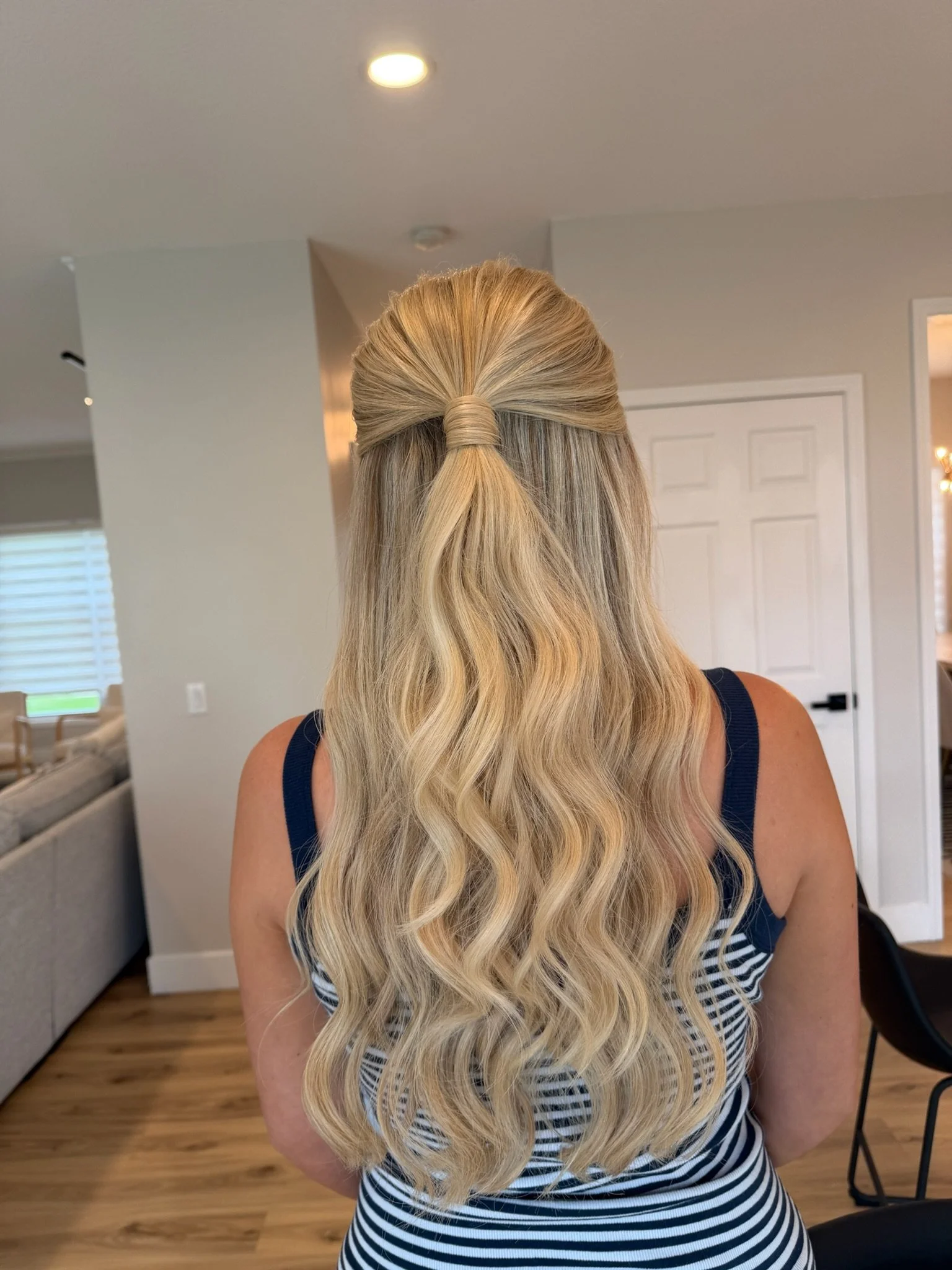
If your wedding inspiration board has a low bun beside glossy waves and a half-up style, start with how you like to wear your hair. Do you feel most like yourself with it off your shoulders, falling around your face, or pulled back just enough to stay out of the way?
That preference gives you a useful starting point. From there, you can work through your neckline, accessories, hair texture and plans for the day. Each of these three styles offers plenty of room to make the look your own.
An updo brings the shape above your shoulders
A sleek low bun and a soft, textured updo belong to the same family, but they create very different looks. A compact bun keeps the shape close to your head. A looser arrangement can add fullness, height or soft pieces around your face. Decide which parts appeal to you before choosing a reference photo.
Putting your hair up can show off the back of your outfit, leave space around a detailed neckline and keep the lengths off your shoulders. Look at the front as carefully as the back. Your part, the height at the crown and the amount of hair left around your face will affect what you see in the mirror and in most portraits.
Hollywood waves make the wave pattern the focus
Hollywood waves have a polished, arranged pattern that runs through the lengths. Bring a photo of the finish you mean, since an inspiration search may mix those defined waves with softer, separated curls.
Look at the direction of the hair as well as the curls. Do you like it swept over one shoulder, tucked behind one ear or falling on both sides? A side view can help show where the waves sit against your neckline. If you want a comb or headpiece, discuss where it can sit without hiding the part of the pattern you love.
Your stylist will need to consider your length, texture and fullness when planning the look. Ask which details can be created with your own hair and whether any suggested added hair serves a specific purpose. The goal might be more fullness through the ends rather than extra length.
Also consider how you move through the day. If you often tuck your hair behind your ears, sweep it over your shoulders or run your hands through it, mention that. An arranged wave pattern needs different handling from loose curls. Ask how to adjust the hair if it shifts and what kind of touch-up, if any, you can comfortably manage yourself.
Half-up hair leaves length on show
A half-up style can feel familiar if you usually wear your hair down but like the front held back. The secured section might be a small twist at each temple, a fuller crown or a more detailed arrangement at the back. The remaining hair can be smooth, wavy or styled in your natural texture.
Compare how much hair you want pulled back. A small section leaves more fullness around the face; taking back a larger section creates a more open front view.
You’ll still have loose lengths resting on your outfit, so think about where you want those to fall. A decorative section at the back also needs space alongside a veil or comb.
Use your own hair as the starting point
Bring a few references and say what you like in each: the front of one style, the fullness of another or the way a third works with a veil. This gives your stylist more to work with than trying to copy one photograph exactly.
Share how your hair usually behaves. Does it hold a curl, get fuller outdoors or lose volume at the crown? Explain what you enjoy about your natural texture and what you want to keep. Your wedding hairstyle can be built around those preferences.
Our guide to hairstyles and face shape offers ideas for framing the face. Use it to explore shapes you like, with your own taste guiding the choice.
If extensions, a haircut or a color change come up, ask how they would help the finished style. Agree on any added cost, sourcing and preparation before including them in your plans. You can also ask what the stylist would suggest using your hair as it is now.
Try the look with the day in mind
At a hair trial, spend a little time wearing the style rather than only photographing it. Turn your head, sit down and check how the hair feels against your neck and shoulders. Bring the accessories your stylist requests. Check their placement, discuss how the veil will come out, and speak up about pulling or pins pressing into your scalp. Take pictures from the front, sides and back to review the whole look.
For a Kansas City wedding with outdoor portraits and an indoor reception, tell your stylist how much time you expect to spend outside. Wind, rain and humidity can affect any hairstyle. Discuss a practical backup for the outdoor portion and how to handle veil removal or an outfit change.
Before leaving, explain any adjustment you’d like: less height, a softer front, fewer loose pieces or a different accessory position. Ask whether those changes can be recorded for the wedding day or would benefit from another appointment.
Price the hairstyle you’ve chosen
Beauty Culture’s styling menu lists special occasion styling and updos from $100. Ask for a bridal-hair quote for your specific look. A simple-looking finish can still take careful work, so appearance alone won’t tell you its price or appointment length.
Get separate prices for the hair trial, wedding-day styling and any added hair. If you’d like services at your venue or touch-ups later in the day, ask whether your chosen professional offers them and what they would cost. The published $200 bridal trial is for makeup; a hair trial needs its own quote.
When you’re ready to talk through your favorite look, explore the Beauty Culture team and use our booking page, or call (816) 603-2819 for help finding the right appointment. We’re at 501 Southwest Blvd in Kansas City’s Crossroads.